
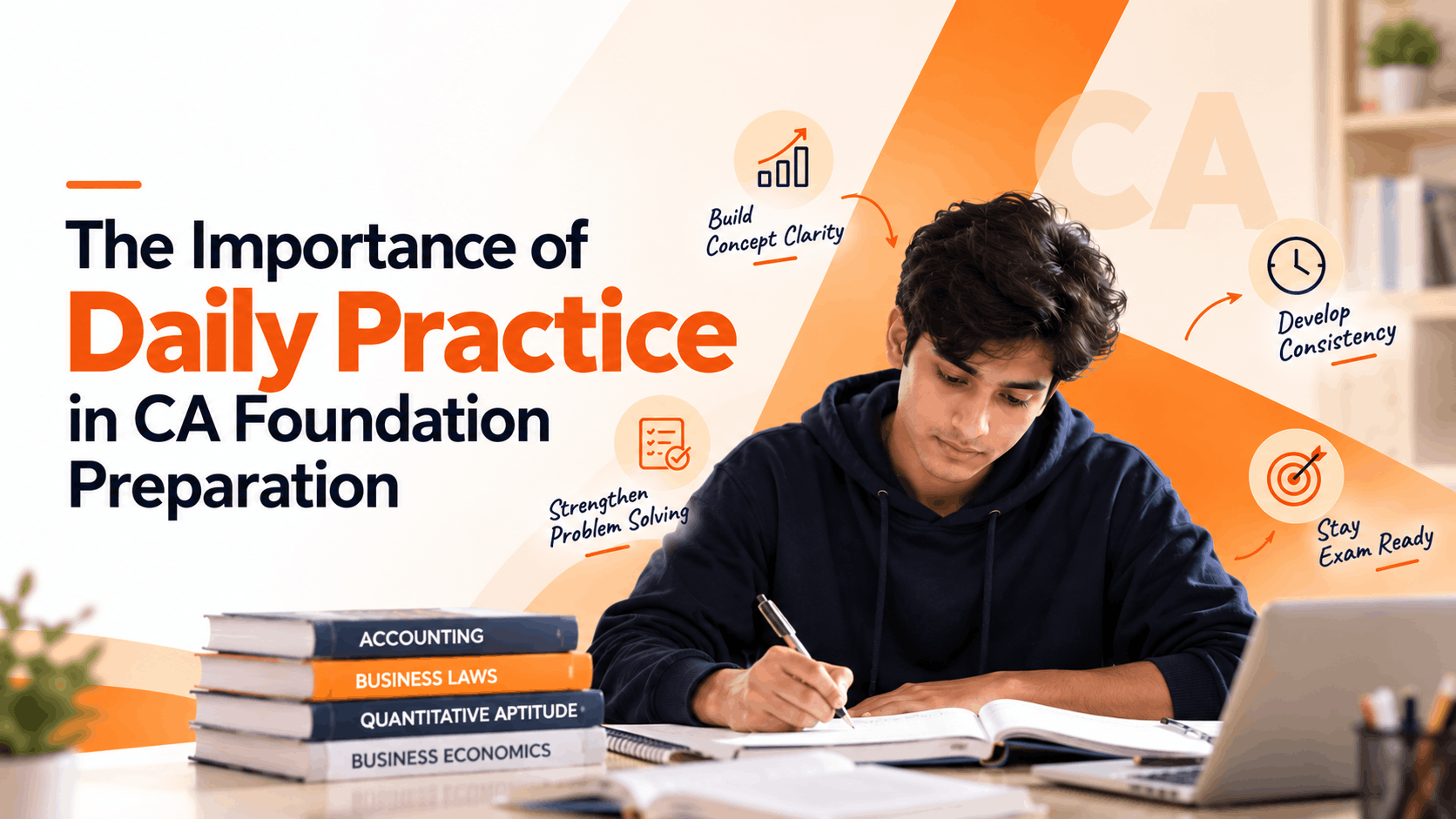
The Importance of Daily Practice in CA Foundation Preparation
Preparing for the CA Foundation examination requires more than understanding concepts. Students need regular practice, revision, problem-solving, and exam-oriented preparation to build confidence and accuracy. A consistent approach can make a significant difference, particularly when students have to manage multiple subjects and a broad syllabus.
Effective CA Foundation Preparation involves not only learning but also practicing. The students will be able to enhance their learning through regular question solving, analyzing their errors, taking practice tests, and keeping track of their progress. Avinash is dedicated to enabling the students to understand structured learning methods and prepare effectively for professional courses like chartered accountancy.
Why Daily Practice Is Essential for CA Foundation Success? :
Daily Practice Is an Essential Component for Preparation for the CA Foundation Exam.
Students will gain an understanding of the subject matter by studying the concepts once, but they will need to keep practising the same concepts in order to increase their retention level and problem-solving skills.
CA Foundation students need to prepare for various kinds of questions in each subject. Practising on a daily basis will help them spot tough areas, get familiar with question patterns, and solve the problems in a fixed amount of time.
Moreover, daily practice will help students avoid having to do a lot of unprepared syllabus at the end of their preparation period.
Building a Consistent Study Routine :
A systematic study routine helps in organizing one’s preparation process. This means that instead of studying all day on particular days, students can use their time throughout the week to study for different subjects.
The following can form a good CA Foundation Study Plan:
- Concepts
- Questions practice
- Revision
- Test practice
- Question paper practice
- Analysis of errors
- Short breaks
- Weekly assessment of progress
This plan must be practical and flexible. While designing their routines, students need to take into account their other academic commitments, their own pace of studying, and their level of preparation.
Avinash Group of Institutions helps its students in approaching their professional careers in commerce with a planned and systematic mindset, whereby consistency becomes an integral part of their academics.
Benefits of Solving Practice Questions Every Day :
Answering questions daily is quite advantageous in the preparation of CA Foundation.
-
Better Concept Retention :
Repetition ensures that concepts are reinforced and makes it easy to recall facts while answering questions in exams.
-
Improved Problem-Solving Ability :
Students feel more at ease determining the right approach when faced with various types of questions.
-
Greater Speed :
Practice makes students aware of calculations, formulas, concepts, and types of questions.
-
Fewer Repeated Mistakes :
Keeping an error log could help students recognise their mistakes and improve on them.
-
Increased Confidence :
It will help students gain more clarity regarding their preparation status through consistent completion of practice questions.
Improving Accuracy Through Regular Revision :
It is not only speed that counts in examinations, but accuracy too. One may be knowledgeable about something, but mistakes can cause one to lose marks due to wrong calculations, wrong interpretation, incompleteness in answering, or poor time management.
Revision will help avoid all this.
A simple revision cycle can include:
| Preparation Stage | Recommended Focus |
| Daily | Revise concepts studied that day |
| Weekly | Review important topics and mistakes |
| Monthly | Revise completed portions of the syllabus |
| Pre-exam | Focus on formulas, concepts, weak areas and practice papers |
Revision notes, which should be concise, must include significant formulae, definitions, and concepts and the errors which are frequently made by students.
The Importance of Mock Tests and Sample Papers :
CA Foundation Mock Tests are an important part of exam preparation because they allow students to practise under examination-like conditions.
The mock tests are helpful for students to understand:
- How efficiently they are managing time
- What subjects need more attention
- Whether they are making any avoidable mistakes
- How to Prepare for the CA Foundation Exam?
- Whether they are answering questions within the allotted time
- What Are the Best CA Foundation Preparation Tips?
Students should not simply attempt a mock test and move on. The most important step is to analyse the results and identify areas that need improvement.
After each mock test, students will be able to categorise mistakes such as
Conceptual mistake —> Calculation mistake –> Question interpretation mistake –> Time management mistake –> Carelessness
This would make mock-test practice more fruitful.
Time Management During CA Foundation Preparation :
Time management should be planned well before the exam, rather than on the day of the exam itself.
The students can allocate time for studying each subject based on their syllabus and their strengths in that particular subject. Hard subjects can be practiced more whereas easy subjects can just be revised.
While practicing, students can use a stopwatch to increase their speed gradually.
For instance:
Study —> Practice —> Use stopwatch —> Review your answers —> Identify mistakes —> Try again
This can help students become more efficient in exams.
Common Mistakes Students Should Avoid :
Even highly motivated students make preparation errors. Here are some common ones:
Studying Without a Plan :
Beginning each day without knowing what is required can result in inconsistent preparation.
Focusing Only on Theory :
Reading concepts without solving questions can make it difficult to apply knowledge during the examination.
Ignoring Weak Subjects :
Students sometimes spend more time on subjects they enjoy while avoiding difficult areas.
Not Analysing Mock Tests :
Taking multiple tests without reviewing mistakes reduces the learning value of those tests.
Leaving Revision Until the End :
Delaying revision can make it difficult to remember earlier topics when the examination approaches.
Comparing Study Hours :
Students have different learning speeds and responsibilities. Instead of comparing hours with others, aspirants should focus on consistency, understanding, and measurable progress.
Effective Daily Study Schedule for CA Aspirants :
There is no single schedule that works for every student. However, a balanced daily routine can include different types of activities.
| Study Activity | Suggested Purpose |
| Concept Study | Understand new topics |
| Practice Questions | Apply concepts |
| Revision | Strengthen memory |
| Error Review | Correct recurring mistakes |
| Mock/Timed Practice | Improve speed and exam readiness |
| Progress Tracking | Measure preparation |
Students can adjust the duration according to their preparation stage. During the early phase, more time may be spent understanding concepts. As the examination approaches, practice, revision, and mock tests can occupy a larger part of the schedule.
Tracking Your Preparation Progress :
Tracking progress makes a CA Foundation Study Plan more measurable.
Students can maintain a simple weekly tracker containing:
- Topics completed
- Questions attempted
- Questions answered correctly
- Topics requiring revision
- Mock-test scores
- Common mistakes
- Pending syllabus
- Revision status
For example, if a student consistently performs poorly in a particular topic, that topic can be added to the next week’s revision schedule.
Avinash Group of Institutions incorporates such structured approaches into educational content and guidance, helping students understand that preparation is a continuous process rather than a single-stage activity.
Staying Motivated Throughout the Preparation Journey :
CA preparation can be demanding, particularly when students encounter difficult topics or lower-than-expected practice scores. Motivation can be maintained by setting smaller and measurable goals.
Instead of thinking only about completing the entire syllabus, students can set goals such as:
Today: Complete one topic
This week: Finish two chapters and one practice test
This month: Complete a defined portion of the syllabus
Celebrating small improvements can help students maintain consistency.
Students should also remember that a poor mock-test score is feedback, not necessarily a final indication of examination performance. The purpose of practice is to identify areas that can be improved.
Last-Minute Revision Strategies :
As the examination approaches, students should avoid trying to learn the entire syllabus from scratch. Instead, the focus should shift toward revision and practice.
Useful last-minute strategies include:
- Revise important formulas and concepts
- Review error logs
- Solve selected practice questions
- Attempt timed mock tests
- Review previous mistakes
- Focus on weaker topics
- Avoid unnecessarily starting large new topics
- Maintain a consistent sleep schedule
- Organise examination materials in advance.
A focused final revision can help students enter the examination with greater familiarity and confidence.
Conclusion :
Regular studying is an integral component of efficient CA Foundation Exam Preparation. Students who regularly practice concepts, solve questions, revise studied topics, write CA Foundation Mock Tests, and analyse their mistakes may become better prepared for exams with time.
The CA Foundation Study Plan should be planned not only in terms of the number of study hours. The plan should include a balance between understanding of topics, practice, revision, accuracy, speed, and monitoring of progress. Moreover, students should stay flexible and change their schedule where necessary upon detecting weak points.
In conclusion, preparation for CA Foundation Exams requires regular effort from students rather than occasional intensive preparation. By creating a practical schedule, practising questions daily, analysing mistakes, taking mock tests, and staying motivated, CA aspirants can prepare efficiently. Aligning with these preparation strategies, Avinash Group of Institutions has created a structured CA Foundation plan for its students, helping them follow a systematic approach to learning, regular practice, and exam preparation.
FAQs
How many hours should I study daily for the CA Foundation exam?
There is no universal number of hours suitable for every student. The ideal study duration depends on the student's preparation stage, existing knowledge, daily commitments, and learning pace. Quality, consistency, and focused study are more important than simply counting hours.
Are mock tests necessary for CA Foundation success?
Mock tests are highly useful because they provide opportunities to practise time management, identify weak areas, assess accuracy, and become familiar with examination conditions. Students should analyse their mistakes after each test.
What is the best daily study plan for CA Foundation preparation?
A balanced daily plan can include concept learning, question practice, revision, error analysis, and timed practice. Students should divide their available time across subjects and adjust the plan based on their progress.
How can I improve my speed and accuracy in the CA Foundation exam?
Regular timed practice can improve speed, while careful revision and error analysis can improve accuracy. Students should identify the reasons behind incorrect answers and practise similar questions until the concept becomes clear.
How often should CA Foundation aspirants revise?
Revision should be continuous rather than limited to the final weeks. Daily revision, weekly review, and periodic revision of completed chapters can help students retain concepts more effectively.
Should students solve sample papers during CA Foundation preparation?
Yes. Sample papers and practice papers can help students become familiar with question formats, practise applying concepts, and develop examination strategies.
What should students do if they are weak in one CA Foundation subject?
Students should identify the specific topics causing difficulty and allocate additional practice time to them. Breaking difficult chapters into smaller sections and solving questions progressively can make preparation more manageable.


Similar Blogs
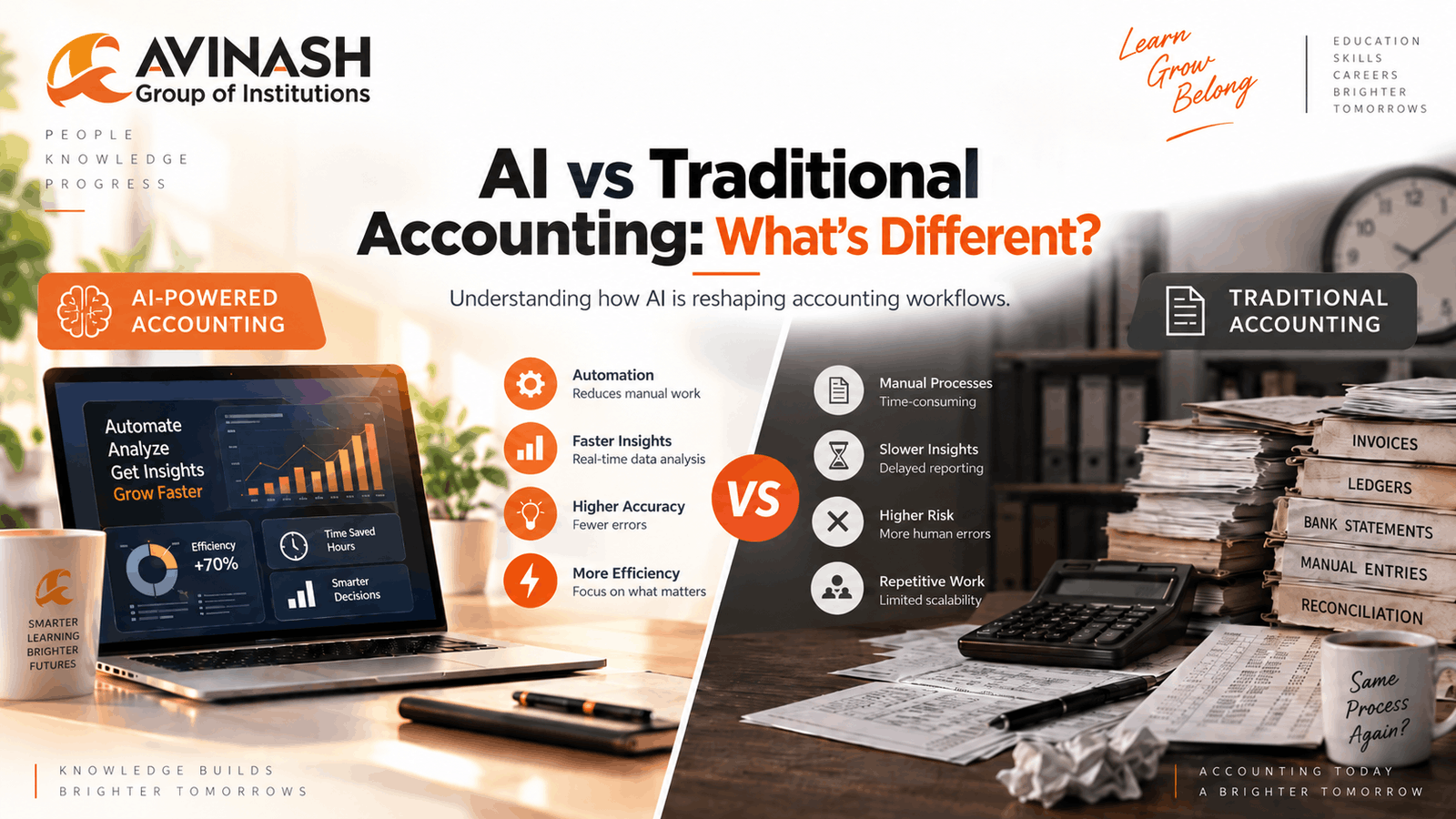
AI vs Traditional Accounting: What’s Different?
Artificial intelligence is changing how businesses record, analyse, process, and interpret financial information. While Traditional Accounting Methods rely heavily on manual processes, established accounting software, reconciliations, and professional review, AI-powered systems can automate repetitive tasks, identify patterns, process large datasets, and provide faster insights. It is also not true to say that traditional accounting is... AI vs Traditional Accounting: What’s Different?
Top AI Certifications for Commerce and Finance Students
Artificial Intelligence (AI) is transforming the way businesses manage data, analyse financial information, automate repetitive tasks, detect risks, and make strategic decisions. As finance and commerce roles become increasingly technology-driven, students with a combination of business knowledge and AI skills can build a stronger foundation for future careers. For commerce students, studying AI does not... Top AI Certifications for Commerce and Finance Students
Benefits of Pursuing CA Alongside a Degree
For commerce students, making a decision about a career after Class 12 becomes crucial. Although earning a bachelor’s degree is a source of academic knowledge, pursuing Chartered Accountant CA Alongside Degree can help students enhance their career prospects. Doing so, students will be able to acquire academic knowledge by earning the degree and develop skills... Benefits of Pursuing CA Alongside a Degree

How ACCA Prepares Commerce Graduates for Global Career Success?
Making the best choice when it comes to professional qualification is one of the crucial decisions made by students that will affect their future careers in finance and accounting. In today’s world where businesses operate in international markets, the demand for professionals having internationally recognised skills and certifications is increasing day by day. The ACCA... How ACCA Prepares Commerce Graduates for Global Career Success?

Why B.Com (Hons) + ACCA Is Best for Global Careers
In today’s competitive and globally connected world, accounting professionals need more than just a traditional degree to stand out. One of the most powerful academic combinations that is gaining attention is B.Com with ACCA. This integrated program blends the theoretical foundations of commerce with the internationally recognised professional credential of the Association of Chartered Certified... Why B.Com (Hons) + ACCA Is Best for Global Careers

Top Courses You Can Pursue Along with Bcom
A Bachelor of Commerce (B.Com) degree lays a strong foundation in accounting, finance, and business management. However, to stand out in today’s competitive job market, pursuing additional courses alongside your B.Com can be a smart move. These courses will enhance your knowledge, skills, and career opportunities. Here are some of the top courses you can consider.

Comparing CA and ACCA : Which Course Is Right for You?
When deciding on a career in finance or accounting, two of the most popular options are the Chartered Accountant (CA) and the Association of Chartered Certified Accountants (ACCA) qualifications. Both courses are well-respected globally and can open doors to various career opportunities. However, choosing between them can be challenging. In this blog, we’ll explore the key differences between CA and ACCA to help you decide which one suits your goals best.

Unlocking Your Global Potential the ACCA Course Explained
The Association of Chartered Certified Accountants (ACCA) is a prestigious, globally recognized accounting qualification with over 200,000 members and 600,000 students worldwide. In India, ACCA is comparable to CA, making it a valuable credential for commerce and accounting careers. Avinash College of Commerce offers comprehensive ACCA training, covering syllabus, eligibility, and fee structure, along with exemptions for qualified students. With a strong focus on academic excellence, placement support, and soft skills development, Avinash College prepares students for successful careers in the global accounting field.