
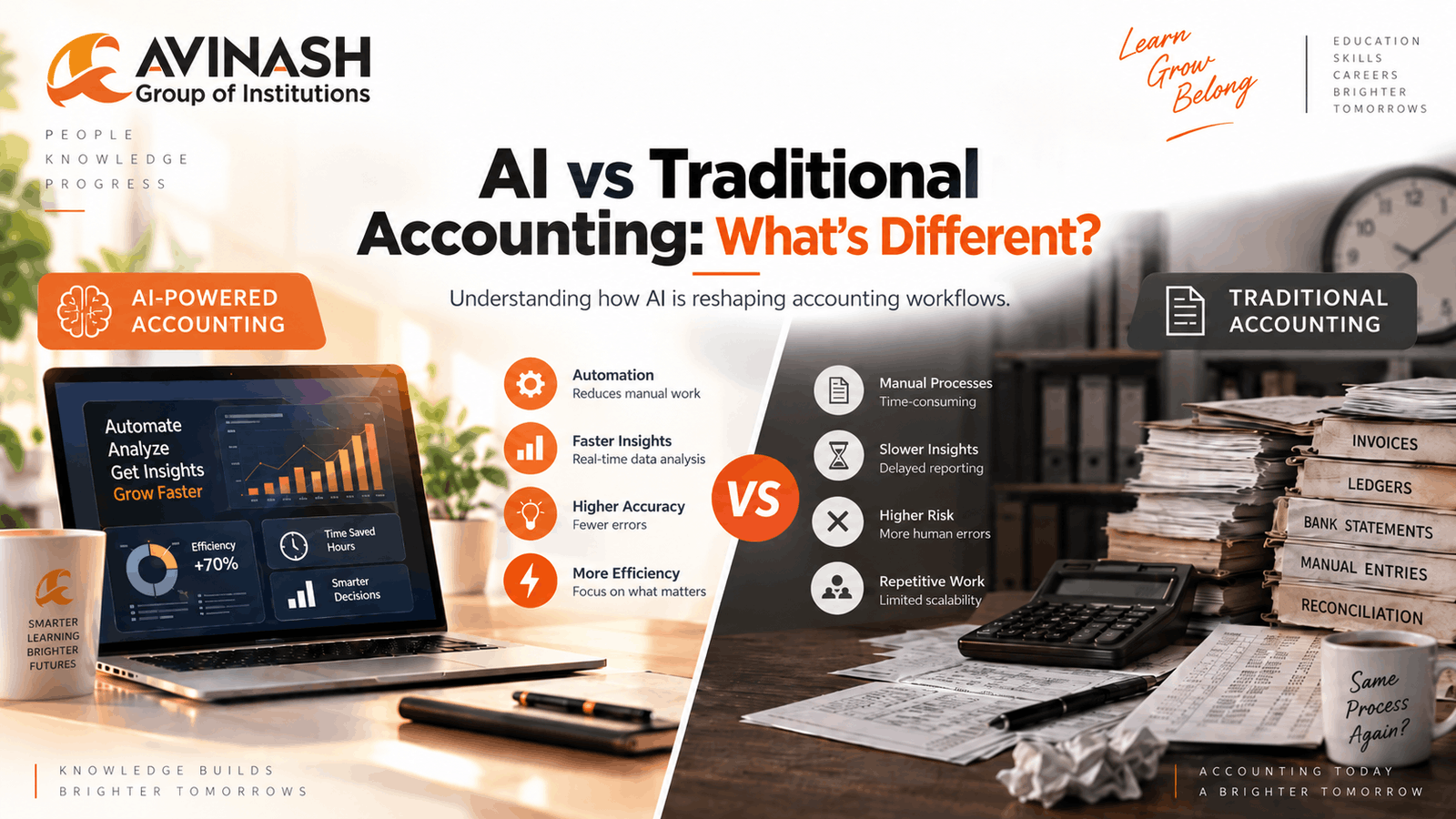
AI vs Traditional Accounting: What’s Different?
Artificial intelligence is changing how businesses record, analyse, process, and interpret financial information. While Traditional Accounting Methods rely heavily on manual processes, established accounting software, reconciliations, and professional review, AI-powered systems can automate repetitive tasks, identify patterns, process large datasets, and provide faster insights.
It is also not true to say that traditional accounting is no longer relevant. Rather, the future of the accounting profession seems to consist of technology along with human expertise. Accountants need to know how AI-based technology in Accounting can help them do their job and continue to provide professional oversight.
For commerce students, this is why awareness of technology has become even more crucial. There are several specialisation options in B.Com at Avinash College of Commerce such as Finance, Business Analytics, Computer Applications, Taxation, and Honours.
Understanding Traditional Accounting Practices
Accounting traditionally entails recording, classifying, summarizing and analyzing transactions on the basis of accepted accounting practices and organizational practices.
While accountants now use accounting software, there are some areas that need manual intervention. This includes transaction analysis, data entry, account reconciliation, report preparation, document examination and financial interpretation.
Traditional accounting is important due to the fact that financial data needs professional judgment, regulatory knowledge and accountability.
For students, accounting still plays an important role regardless of advances in technology. As per Avinash College of Commerce, the B.Com program provides basics in finance, accounting, economics and business management along with analytical skills.
What Is AI-Powered Accounting?
AI-based accounting applies the principles of artificial intelligence and similar technology for automated or assisted accounting and financial operations.
The application of AI depends on the particular system but includes tasks such as:
- Transaction classification
- Processing of invoices
- Data mining
- Bank statement reconciliation
- Expenses management
- Detecting frauds
- Anomalies spotting
- Financial forecast
- Reporting
- Data analytics
The idea is not only about automation and reduction of manual labor. The use of AI allows accountants to devote more time to data analysis and identification of problems in finances, give advice to companies, and make well-informed decisions.
This is where Artificial Intelligence in Finance becomes very important for business education.
Key Differences Between AI and Traditional Accounting (AI vs Traditional Accounting)
The biggest difference between AI and traditional accounting is the way information is processed.
| Factor | Traditional Accounting | AI-Powered Accounting |
| Data entry | Often requires manual input | Can automate data extraction |
| Processing speed | Depends on manual workflows | Can process large datasets rapidly |
| Repetitive tasks | Human-led | Greater automation |
| Error detection | Manual review and software checks | Pattern and anomaly detection |
| Data analysis | Primarily accountant-driven | AI-assisted analysis |
| Reporting | Prepared through defined processes | Can support automated reporting |
| Decision-making | Human judgement | AI-generated insights + human judgement |
| Scalability | Requires additional resources | Can process larger data volumes |
| Human role | More transaction-focused | More analytical and advisory |
The most effective approach may not be choosing between the two. Businesses can combine automated technology with professional accounting expertise.
Speed and Efficiency Comparison
Speed is among the most distinct ways through which AI accounting differs from manual accounting.
The manual method would involve accountants obtaining documents, entering data, reconciling data, and ensuring accuracy of their work. As transaction volume rises, these processes may take up considerable time.
AI processes can automate some of these tasks. For instance, AI-powered accounting software can extract data from invoices and arrange transaction data before the accountant views it.
It means that Accounting Automation can be highly useful for companies dealing with large amounts of financial data.
In this case, automation can be a critical part of the education of students wishing to join the accounting industry.
Accuracy and Error Reduction
There could be problems in manual accounting such as errors in data entry, duplication of information, mistakes in calculations, or absence of information. Software and AI can help avoid some of these repetitive mistakes through automation and spotting of anomalies.
Nevertheless, AI does not necessarily mean no mistakes.
AI can generate mistakes when the data used in the analysis is incomplete, incorrect, badly organized, or incorrectly analyzed. Human judgment is still important, especially when making financial decisions which might lead to legal or business implications.
That implies that the accountants should know not only advantages but also disadvantages of AI.
Data Analysis and Financial Insights
Traditionally, accounting has been quite efficient in dealing with financial information. AI can enhance these abilities by working with a bigger set of data and finding out things that cannot easily be found through conventional means.
These can include:
- Cash flow forecasting
- Expenses analysis
- Income trends
- Risk identification
- Customer behavior analysis
- Fraud detection
- Budget management
- Financial forecasting
This way, there will be an enhanced link between accounting and business intelligence.
The B.Com Business Analytics program offered by Avinash College of Course deals with data analytics, statistical models, business intelligence, and market trends, which can help with accounting and finance in the era of technology.
Role of Accountants in the AI Era
There will probably be changes in the job of accountants as the process of automation continues.
Instead of being preoccupied with repetitive tasks that are part of data processing, accountants can now pay more attention to:
- Financial analysis
- Business consultation
- Risk assessment
- Regulation
- Strategic planning
- Financial forecasting
- Communication with clients
- Evaluating the results provided by the AI system
Judgment skills are always necessary because there are factors related to the situation, which a machine may not be able to comprehend.
It is important to have a mixture of all these skills and competencies.
Avinash College of Commerce provides courses in B.Com Computer Applications, which is a program that combines technology and commerce through such disciplines as accounting software, database management, programming, and e-commerce.
Benefits and Limitations of Traditional vs AI Accounting
Both approaches have advantages.
Traditional Accounting Methods
Benefits:
- Strong human oversight
- Established processes
- Professional judgement
- Easier contextual interpretation
- Suitable for complex decisions requiring human expertise
Limitations:
- Time-consuming repetitive work
- Greater dependence on manual processes
- Potential for human data-entry errors
- Less efficient when handling very large datasets
AI-Powered Accounting
Benefits:
- Faster processing
- Automation of repetitive tasks
- Large-scale data analysis
- Pattern and anomaly detection
- Potentially faster reporting
- Improved operational efficiency
Limitations:
- Implementation costs
- Dependence on data quality
- Cybersecurity and privacy considerations
- Need for human supervision
- Potential for incorrect AI-generated outputs
The best solution for many organisations may therefore be a hybrid approach.
Will AI Replace Accountants?
AI will not remove the need for accountants but rather change the nature of their work.
The mundane activities will be automated while human experts deal with the judgement, advisory, regulatory, strategic and relationship-oriented work.
This explains why it is imperative for accountants to continuously learn.
This can be achieved by equipping oneself with the basics of accounting together with data, technology, communications, business intelligence, and AI knowledge.
According to Avinash College of Commerce’s B.Com courses, there are options in Finance and Business Analytics apart from the Skills Development Centre which is geared towards finance and accounting careers with an emphasis on new technologies such as analytics and artificial intelligence.
The Future of Accounting and Human Expertise
The future of accounting will see automation paired with human skill, not the replacement of one by the other.
AI has the ability to analyse information, detect patterns and perform automated tasks. On the other hand, an accountant can analyse the data, question assumptions, adhere to professional guidelines, interact with stakeholders, and decide based on the business context.
This development requires a change in accounting education, too. It is important not just to learn about accounting but to know how technology changes financial operations.
Students at Avinash College of Commerce have the option of choosing a specialisation within the B.Com curriculum, including Finance, Business Analytics and Computer Applications. The college’s programs are focused on developing skills that are industry-specific and help prepare for a future career.
Conclusion
The comparison between AI and Traditional Accounting need not be an attempt to choose the successor from among these two. Traditional accounting serves the need of providing principles, expert judgment, control, and financial expertise to organizations whereas AI can assist in increasing the speed, automation, analysis, and efficiency.
In this light, with the development of AI in Accounting, professionals who possess knowledge of both traditional accounting and the new technology can have an advantage. Future of Accounting Profession is expected to demand from accountants working with smart systems with more emphasis on interpretation, strategy, compliance, and decision-making.
For commerce students, it can be useful to gain these complementary skills. Avinash College of Commerce offers B.Com courses in General, Taxation, Computer Applications, Honours, Business Analytics and Finance along with career-oriented learning aimed at building the foundation of careers in the field of commerce and finance. Its Skill Development Centre also concentrates on careers in finance and accounting and the increased significance of analytics and artificial intelligence.
FAQs
Can AI completely replace accountants?
No. AI can automate several repetitive tasks in accounting, but accountants play a critical role when it comes to professional judgment, compliance, interpretation, strategic guidance, ethics, and decision making.
How does AI improve accounting accuracy?
AI can help minimise some manual data entry and processing mistakes by automating routine processes and spotting irregularities. However, a human check is required as AI systems may make mistakes too.
What are the benefits of traditional accounting methods?
Traditional accounting offers human control, professional judgement, procedures, context, and accountability, especially for making difficult financial decisions.
Is AI accounting suitable for small businesses?
AI accounting may help automate processes; however, small businesses have to take into consideration costs of the software, number of transactions, data security issues, and the extent of human supervision that is needed.

Similar Blogs
The Importance of Daily Practice in CA Foundation Preparation
Preparing for the CA Foundation examination requires more than understanding concepts. Students need regular practice, revision, problem-solving, and exam-oriented preparation to build confidence and accuracy. A consistent approach can make a significant difference, particularly when students have to manage multiple subjects and a broad syllabus. Effective CA Foundation Preparation involves not only learning but also... The Importance of Daily Practice in CA Foundation Preparation
Top AI Certifications for Commerce and Finance Students
Artificial Intelligence (AI) is transforming the way businesses manage data, analyse financial information, automate repetitive tasks, detect risks, and make strategic decisions. As finance and commerce roles become increasingly technology-driven, students with a combination of business knowledge and AI skills can build a stronger foundation for future careers. For commerce students, studying AI does not... Top AI Certifications for Commerce and Finance Students
Benefits of Pursuing CA Alongside a Degree
For commerce students, making a decision about a career after Class 12 becomes crucial. Although earning a bachelor’s degree is a source of academic knowledge, pursuing Chartered Accountant CA Alongside Degree can help students enhance their career prospects. Doing so, students will be able to acquire academic knowledge by earning the degree and develop skills... Benefits of Pursuing CA Alongside a Degree

How ACCA Prepares Commerce Graduates for Global Career Success?
Making the best choice when it comes to professional qualification is one of the crucial decisions made by students that will affect their future careers in finance and accounting. In today’s world where businesses operate in international markets, the demand for professionals having internationally recognised skills and certifications is increasing day by day. The ACCA... How ACCA Prepares Commerce Graduates for Global Career Success?

Why B.Com (Hons) + ACCA Is Best for Global Careers
In today’s competitive and globally connected world, accounting professionals need more than just a traditional degree to stand out. One of the most powerful academic combinations that is gaining attention is B.Com with ACCA. This integrated program blends the theoretical foundations of commerce with the internationally recognised professional credential of the Association of Chartered Certified... Why B.Com (Hons) + ACCA Is Best for Global Careers

Top Courses You Can Pursue Along with Bcom
A Bachelor of Commerce (B.Com) degree lays a strong foundation in accounting, finance, and business management. However, to stand out in today’s competitive job market, pursuing additional courses alongside your B.Com can be a smart move. These courses will enhance your knowledge, skills, and career opportunities. Here are some of the top courses you can consider.

Comparing CA and ACCA : Which Course Is Right for You?
When deciding on a career in finance or accounting, two of the most popular options are the Chartered Accountant (CA) and the Association of Chartered Certified Accountants (ACCA) qualifications. Both courses are well-respected globally and can open doors to various career opportunities. However, choosing between them can be challenging. In this blog, we’ll explore the key differences between CA and ACCA to help you decide which one suits your goals best.

Unlocking Your Global Potential the ACCA Course Explained
The Association of Chartered Certified Accountants (ACCA) is a prestigious, globally recognized accounting qualification with over 200,000 members and 600,000 students worldwide. In India, ACCA is comparable to CA, making it a valuable credential for commerce and accounting careers. Avinash College of Commerce offers comprehensive ACCA training, covering syllabus, eligibility, and fee structure, along with exemptions for qualified students. With a strong focus on academic excellence, placement support, and soft skills development, Avinash College prepares students for successful careers in the global accounting field.